Dalit Buddhist identity and conversion
Serious MenDalit Buddhist identity and conversion in the novel are not a simple passage from one faith to another. For Ayyan Mani, renouncing Hinduism is a refusal of a religious order bound to caste humiliation; at home, however, his wife Oja presses him to make room for Hindu gods, stories, and rituals in their son’s life. Their disagreement exposes the difference between declaring a new identity and living with the culture, deprivation, and social history that surround it.
Identity Against Caste
Ayyan tells Sister Chastity that he has long renounced Hinduism and is a Buddhist. Her response unsettles the distinction he is trying to defend: she regards Hinduism and Buddhism as much the same. She has just praised him for forgiving the Brahmins who brutalized his forebears, while also telling him that people who use the public name Dalits may still privately call them Untouchables. Ayyan insists that he has not forgiven them. His Buddhist identity is therefore not presented as a reconciliation with the hierarchy or as proof that its injuries have passed; it is a declared break with a religious order he regards as cruel.
His account of caste is at once historical and intimate. He describes Brahmins as having had millennia to build worlds of education, English, books, bridges, and socialism, while he arrived as a Dalit child of a sweeper in a one-room home. The contrast is not between innate intelligence and lack of it, but between inherited opportunity and the demand that the excluded admire what others have accumulated. When Ayyan invokes generations of advantage, he rejects the idea that visible achievement can be separated from the social conditions that made it possible.
The novel places that claim beside a concrete account of caste exclusion: a Dalit minister recounts being tied to a tree by Brahmin priests for entering a temple when he was a boy. He escaped to Bombay the next morning with almost nothing. The story gives the temple more than symbolic importance. Access to it could be violently policed, while the memory of exclusion remained part of the minister’s later public and political life. Religious identity in this setting is inseparable from who may enter, who is punished, and who carries the memory forward.
Oja’s Claim to Religious Belonging
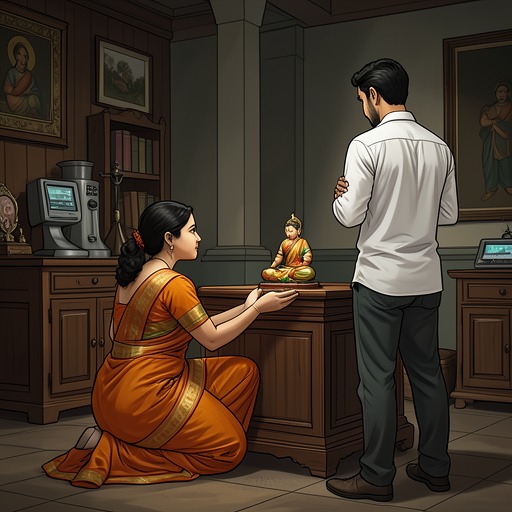
Oja’s disagreement with Ayyan is not simply a theological counterargument. She wants gods in the home, a temple visit for Adi Mani, and festivals that make family life resemble the religious life she sees around them. She says that she is Hindu and resists the idea that the family must pretend otherwise. Where Ayyan sees the gods of an oppressive upper-caste tradition, Oja sees a source of participation and a world her son should be able to know.
Their argument takes visible form in the elephant-headed Ganesha idol Oja hides in the washing machine. Ayyan has thrown away earlier idols on his way to work, yet every few months the god returns in a different mood. When he finds this one, he wraps it in newspaper and says he will dispose of it the next day. Oja objects that he cannot keep doing this. The recurring object turns an abstract dispute over conversion into a domestic contest over what may occupy their shared home.
Oja also interprets Adi’s near-total deafness in his left ear as a sign that the gods are angry. She regards the Buddha’s smile as the peace of someone without cosmic power, while believing that the Hindu gods possess magic. Her grief gives religious practice a personal urgency: she wants protection and explanation, not only a public label. Ayyan cannot accept her reasoning, but he cannot bear to see her cry. Rather than answer her pain with another argument about caste, he reaches for a fact about the muscles in an elephant’s trunk, recalling the small curiosities he once shared to make her marvel at the world.
Inheritance, Stories, and Compromise
Ayyan does not resolve the disagreement by treating all Hindu stories as worthless. He recognizes that Adi is growing up without cultural influence and that the epics he distrusts are also the epics available to his son. To him, the Mahabharata offers moral complexity beyond the simpler opposition of good and evil: the virtuous may choose wrongly, demons may be fundamentally kind, and gods may behave badly. He wants Adi to encounter those stories, and to learn morals, patriotism, and the gods, even while refusing to keep Hindu idols in the house.
This is a qualified, deliberate compromise. Ayyan privately wishes Oja would win the immediate struggle over the stories, but wants the upper-caste religion used in the home for education and entertainment rather than as an authority over their identity. He hopes that when Adi is twenty he will be intelligent enough to abandon it. The concession does not erase Ayyan’s Buddhist conviction; it shows him separating cultural knowledge from religious allegiance, even as Oja asks for a fuller, more lived belonging than he is willing to grant.
The Limits of Conversion
The family’s argument unfolds amid material inequalities that religious self-definition cannot by itself remove. Ayyan’s account of being the son of a sweeper in a one-room home makes social position concrete; later, after Adi’s supposed brilliance has drawn attention, he urges the neighbors to sell and move to proper flats for their children’s sake. Public recognition may briefly change how a Dalit family is seen, but it does not make the cramped life they want to leave disappear. The distinction between identity and conditions matters: conversion gives Ayyan a language of refusal, not an instant escape from poverty or inherited stigma.
The novel consequently gives no simple verdict in which Buddhist identity ends the family’s religious conflict. Ayyan’s refusal answers a history of caste injury, while Oja’s insistence answers her wish for gods, festivals, and a shared cultural world for Adi. Their opposing desires meet in the same household, where an idol can be repeatedly removed and returned, and where stories can be welcomed as lessons even when their religious claims are rejected. Conversion is significant precisely because it remains a lived and contested choice rather than a clean break from everything that came before.